
$
$
Product successfully added to your shopping cart.
Most template sellers focus on what they build and how they price it. Far fewer spend enough time thinking about how buyers decide. Understanding buyer psychology — what they look for, what they fear, what builds confidence — is the single most actionable insight you can have as a template seller. These are the seven things that drive purchase decisions.
Buyers in a template marketplace browse visually before they read anything. The main preview image is the first and sometimes only thing that determines whether a buyer clicks through to your product page or keeps scrolling. It is your single most important marketing asset.
A strong preview image shows the template in its best layout on a clean desktop view, uses realistic and aesthetically appropriate demo content, and communicates the template's visual identity immediately. The worst preview images use placeholder text, missing images, or show an incomplete design — these signal a template that is not ready for real-world use, regardless of how good the actual product is.
After the preview image, the live demo is where purchase decisions are made or lost. A buyer who clicks through to your product page and launches the demo is genuinely considering purchasing your template. What they experience in the next 60–90 seconds determines whether they buy.
An effective live demo looks and functions like a real, operational website. It loads quickly on mobile. The navigation works. The product pages or portfolio pages all have content that demonstrates the template's capabilities. Buyers mentally project their own content into your demo — help them do that by making the demo as realistic as possible.
In a marketplace full of unknown sellers, social proof is the primary trust mechanism. A template with 50 sales and a 4.8-star rating from 12 reviews tells a buyer: other people bought this, used it, and rated it highly. That story carries far more persuasive weight than any feature list you could write.
This is why the first 10 reviews are disproportionately important. Below 5 reviews, many buyers hesitate. Above 10, with a strong average rating, conversion rates improve substantially. For new sellers, strategies for generating early reviews include pricing slightly below market and promoting the demo link in communities where potential buyers are active.
Generic descriptions do not sell templates. "A modern, responsive, fully customisable theme for any business" could describe ten thousand templates. It communicates nothing specific and gives the buyer no reason to choose this template over any other.
Specific descriptions sell templates. "A Shopify 2.0 theme with six homepage layouts for fashion and apparel stores, built around a mega menu, a lookbook section, and a quickview feature for high-volume product catalogs" tells a buyer in the fashion niche exactly what they are getting and why it was built for them.
Buyers are purchasing a template they will need to install and configure without your direct involvement. Documentation is the bridge between the purchase and a successful implementation. Poor documentation generates support tickets, bad reviews, and refund requests. Good documentation generates positive reviews and repeat buyers.
A complete documentation package includes: a clear installation guide; a customisation guide covering the theme options; a list of all third-party plugins or dependencies; and a troubleshooting section for the 5–10 most common issues buyers encounter.
More than half of all web traffic is now on mobile devices. Buyers know this about their customers, and they evaluate templates on mobile before they commit to a purchase. A template that looks excellent on desktop and mediocre on mobile will lose sales to a competitor whose mobile experience is equally strong.
Test your template on actual mobile devices — multiple screen sizes if possible, not just browser resize. The navigation should work clearly on small screens. Text should be readable without zooming. The checkout or conversion flow should function smoothly on a touchscreen.
Website performance is a direct factor in Google search rankings and in user experience. Buyers who are building or redesigning a website know this, and they increasingly evaluate templates on loading performance before purchasing. A beautiful template that scores poorly on Google PageSpeed Insights is a liability, not an asset.
When you prepare your template for submission, run it through Google PageSpeed Insights and address any major issues before listing. Then include the performance context in your product description — buyers who are performance-conscious will appreciate the transparency and it removes a common objection.
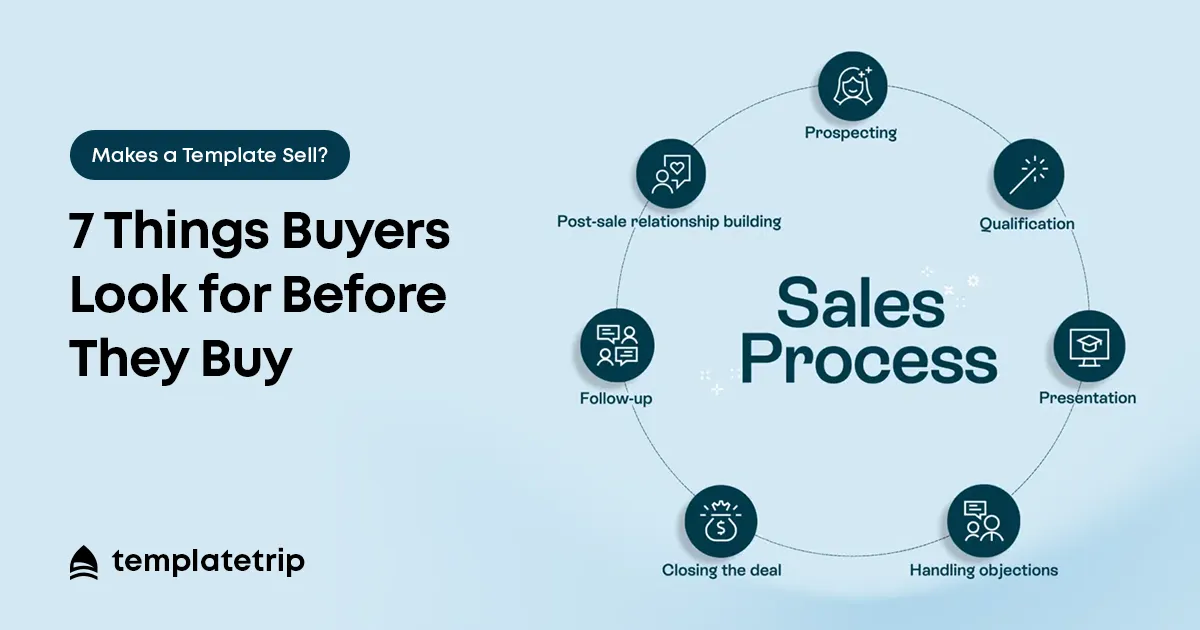
Most buyers move through this flow: preview image catches attention → demo confirms interest → social proof reduces risk → description confirms fit → documentation signals reliability → mobile and speed checks remove technical objections.
A template that performs well at every stage of this flow will convert. A template with one weak link loses buyers at that stage. Review your existing templates against this framework — where are buyers most likely to drop off? That is where your next improvement effort belongs.
what makes a website template sell, template marketplace buyer behavior, how to create sellable templates, template conversion tips 2026