
$
$
Product successfully added to your shopping cart.
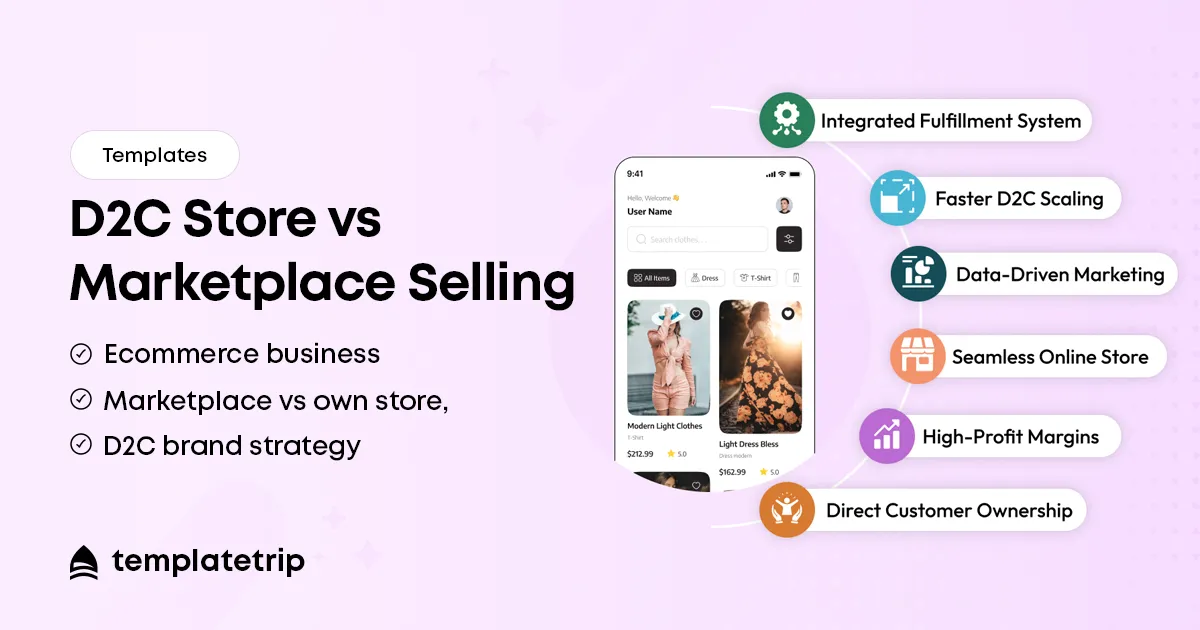
Every new brand faces a version of the same early decision: sell on Amazon, Flipkart, and the major marketplaces where the traffic already is — or invest in building your own store and owning the customer relationship directly. Both approaches have merit. But there is a longer-term strategic reality that is increasingly hard to ignore: the brands that are winning in 2025 and beyond are the ones that chose to own their customers. Levi's now generates over half its revenue through D2C channels. Nike has been systematically withdrawing from third-party retail.
Amazon and Flipkart already have millions of shoppers. A new brand can generate sales within days of listing without building an audience from scratch. For testing product-market fit or generating early revenue, this speed of distribution is genuinely valuable.
FBA and similar programs handle warehousing, packaging, shipping, and returns. For small teams focused on product rather than logistics, this operational offloading is significant. List the product; the marketplace handles the rest.
Customers trust major marketplace platforms. A shopper who has never heard of your brand will buy from you on Amazon because Amazon's buyer protection covers them. That trust transfer is valuable for new brands that have not yet built their own reputation.
Marketplace fees — listing, referral, fulfilment, advertising — typically consume 15–40% of revenue depending on category. Many brands only discover how tight margins are after operating on marketplaces for a year. For low-margin products, marketplace economics can make profitability structurally difficult.
This is the most strategically significant cost, and the most underappreciated. When a customer buys your brand on Amazon, they are Amazon's customer — not yours. No email address. No direct marketing access. No behavioural data beyond what the marketplace shows you. No loyalty programme. Every customer's lifetime value is capped by the platform's rules.
If Amazon changes its algorithm, fee structure, or policy, your business is at risk overnight. Marketplace-dependent businesses have no control over this lever.
Marketplaces are inherently price-comparison environments. Shoppers sort by price. Competitors can see your listings and undercut you. The pressure to lower prices is constant and structural — brands relying on marketplace revenue often find themselves trapped in a dynamic that erodes margins over time.
Your listing sits within the marketplace's brand environment. You are a supplier within their store, not a brand in your own right. Building brand recognition, emotional connection, and community loyalty is nearly impossible in this context.
Every customer who buys from your own store gives you their email address, purchase history, location, and browsing behaviour. This first-party data enables personalised marketing, accurate lifetime value modelling, loyalty programme design, and targeted re-engagement. In a world of increasing data privacy regulations and declining third-party cookies, first-party data becomes more valuable every year. D2C brands are accumulating this asset; marketplace sellers are not.
On your own store, you set the price, control promotions, and keep the margin. A product selling at ₹1,000 with 40% gross margin generates ₹400 in gross profit. The same product on a marketplace taking 25% in fees generates ₹300 — a 25% reduction on every single sale. At scale, this difference separates a profitable business from a struggling one.
Your own store is a canvas. You control visual design, tone of voice, the customer journey, the values you communicate, and the community you build. Brand storytelling, editorial content, lookbooks, loyalty programmes, exclusive products — these are D2C tools. They do not exist in a marketplace listing.
A business with 100,000 email subscribers, a strong repeat purchase rate, and owned customer relationships has fundamentally different equity value than a business with equivalent revenue that is entirely marketplace-dependent. Investors, acquirers, and strategic partners understand this. D2C brands with owned audiences command valuation premiums.
The most sophisticated brands in 2025 use both channels with clarity about each channel's role. Marketplaces serve as discovery and acquisition channels — new customers find the brand there. The D2C store is where those customers become loyal, repeat purchasers with higher lifetime value.
Packaging inserts, QR codes on marketplace orders, and post-purchase email sequences can transition marketplace buyers onto the D2C platform over time.
Strategic principle: Use marketplaces to acquire. Use your D2C store to retain, upsell, and build community. The margin you sacrifice on marketplace sales is an acquisition cost; the lifetime value you build on D2C is the return.
Marketplace selling is a legitimate channel for discovery, early revenue, and operational simplicity. It is not a long-term brand-building strategy. The brands winning over a 5–10 year horizon are the ones that took the harder path of building direct customer relationships, owning their data, and creating brand experiences that cannot be replicated by a competitor with a cheaper listing on the same platform. That is the asymmetric bet the best brands in the world are making — and winning.
D2C vs marketplace, direct to consumer vs marketplace, should I sell on Amazon or own website, D2C ecommerce benefits, D2C brand strategy, marketplace vs own store, flipkart vs own website, D2C store India, ecommerce business model